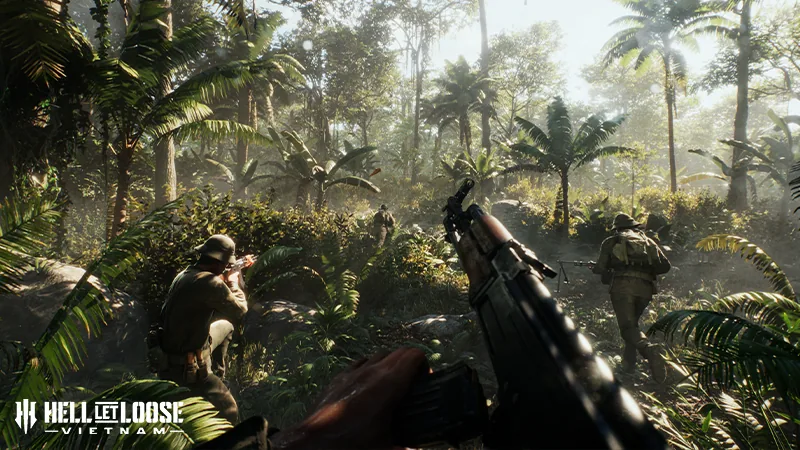
Current build
Command and squad language
Commander is the role associated with command and coordination across the team surface. Squad Leader is the role associated with squad leadership. Chain of command describes the relationship that keeps a large match organized, while squad teamwork describes the local movement and support that turns a command task into a route. Say sector, route and fallback together when the squad needs a decision rather than a general location.
Warfare uses five sectors as the objective surface. Offensive separates attackers and defenders. Those mode words describe what the team is trying to do, while a map word describes where the action happens. Keeping objective and terrain separate helps a player say ‘attack the river crossing’ or ‘hold the runway edge’ instead of repeating a mode name without a task.
Riverine combat
Armed patrol boats and water movement available to both sides on maps with waterways, crossings and port approaches.
Tunnel networks
Buildable NVA tunnel-network support, the confirmed asymmetric underground surface for the North Vietnamese Army.
Helicopter operations
US aerial fire support and supply drops connected to the Pilot and Logistics Officer roles.
Enhanced movement
Swimming, climbing, fast crawling and dragging injured players as part of the current launch surface.
Warfare
The official five-sector tug-of-war mode surface in which teams push toward the enemy headquarters.
Offensive
A separately named launch mode that separates attackers and defenders rather than using the Warfare sector loop.
Chain of command
The command-and-squad organization that keeps a 50v50 match readable through Commander, Squad Leader and local unit tasks.
Field note
Faction and system language
US Forces are the United States faction surface tied to helicopter fire support and supply drops. The NVA is the North Vietnamese Army surface tied to buildable tunnel networks. Helicopter operations refer to the US aerial support and supply system; tunnel networks refer to the NVA underground support system. Riverine combat refers to armed patrol boats and water movement on both sides. Enhanced movement refers to swimming, climbing, fast crawling and dragging an injured player.
The terms are related but not interchangeable. A Pilot is a role, a helicopter is a vehicle surface and air support is a system effect. An Engineer is a role, a tunnel network is a faction system and a cave is a map surface. Precision in these names makes a short call easier for every unit to act on.
Field note
Map and terrain language
Thanh Hóa Bridge is the bridge and river crossing record associated with Dragon’s Jaw and the Nam Ma River. Huế Outskirts combines mountains, terraced farms, jungle, industrial bases and waterways. Vạn Tường uses a semi-urban jungle and river network surface. Quảng Ngãi combines flooding, cliffs, caves, bamboo and open lowlands. Đắk Tô Airfield uses runway sightlines and open ground. Cam Ranh Port uses docks, dunes and waterways with port logistics.
Use the proper name when orienting the team and the terrain feature when choosing the route. ‘Đắk Tô’ identifies the map; ‘runway edge’ identifies the decision. ‘Thanh Hóa Bridge’ identifies the map; ‘river crossing’ identifies the action. This two-layer language is short enough for voice and specific enough for support, vehicles and reconnaissance to meet.
Field note
Practice the two-layer callout
A new player can practice this vocabulary before joining a crowded match. Pick a map name, name one terrain feature and add the action that feature permits or blocks. For example, a runway implies a sightline and a timing problem; a bridge implies a crossing and a fallback; a dock implies a water approach and logistics space. That sentence gives a Squad Leader more information than a repeated location name.
The same structure works for faction systems. A tunnel can be a hidden fallback, a helicopter can be an opening above a route and a patrol boat can be pressure along a bank. Use the terms with the role and mode records so the callout says who should act and why the sector matters. The terminology file is strongest when it stays close to a player task: name the map, name the surface, name the action and let the correct unit confirm the next move.